


Credits: Thesupermat / Wikimedia Commons, CC BY-SA 3.0.
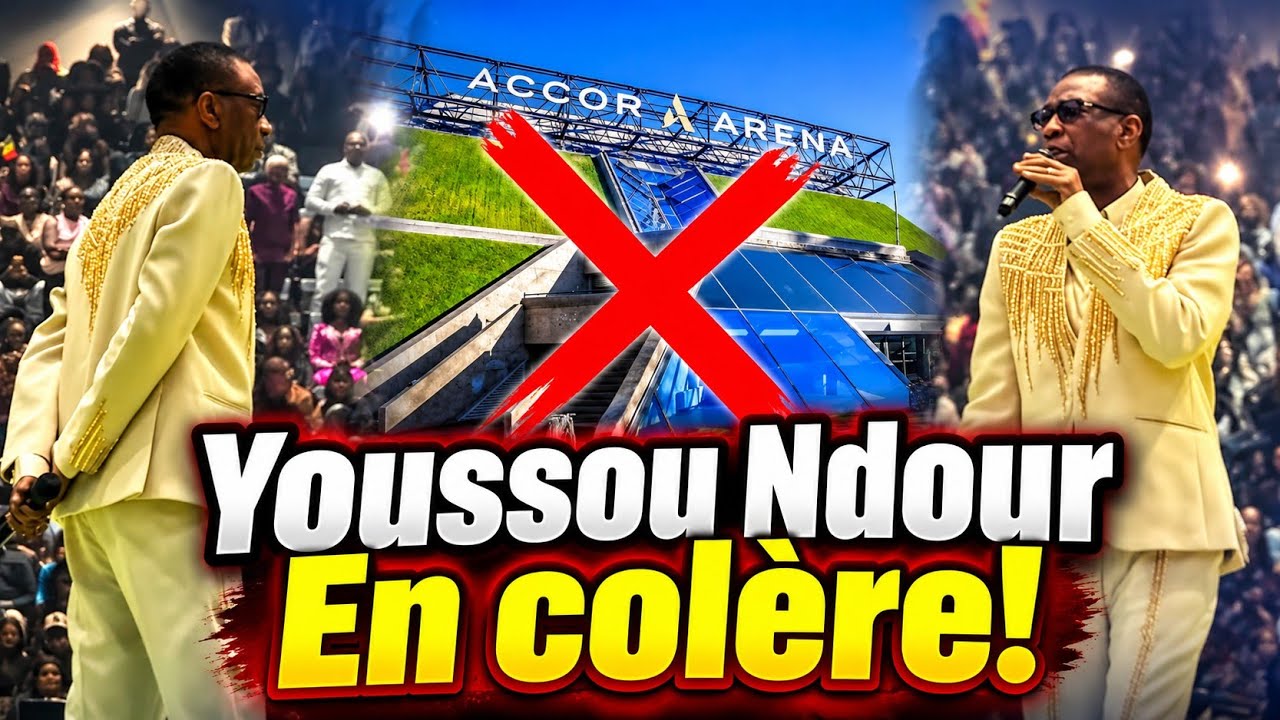
The Senegalese singer’s Grand Ball was interrupted at Accor Arena on the night of October 17 to 18, 2026. The show had started late. Youssou N’Dour challenged the decision, while the venue cites its operating constraints and the safety of audience members. At the heart of the dispute are the entry conditions and the end of the show, several details of which still need to be established.
An Evening Start Marked By Waiting
Youssou N’Dour and Super Étoile de Dakar were together in Bercy for the Grand Ball on Saturday, October 17. The official Accor Arena schedule confirms this date and announces an event starting at 7 p.m. In this text, however, it does not specify whether that time refers to public admission or the start of the performance.
The account from Le Parisien, published on October 18, gives another reference point for the artistic program. The start was scheduled for 8:30 p.m., then the artist went on stage at 9:54 p.m. On that basis, the delay comes to one hour and twenty-four minutes. These reported times should not be confused with a door-opening time, which still needs to be clarified.
One spectator interviewed by the newspaper describes a two- to three-hour wait in line. She explains that the singer reportedly waited to allow the audience to enter. Her account sheds light on the impatience of some spectators, without providing a breakdown of access times for the entire venue.
Fraudulent Tickets, A Production Explanation
To explain the difficulties at the checkpoints, the production told Le Parisien that around 4,000 fraudulent tickets were present. This figure, widely repeated since then, remains a statement from the producers. No public ticketing report currently makes it possible to verify this count. Its precise effect on the delay is also unknown.
The production also disputes the claim that only one entrance had been opened. The state of the access points is therefore another point of disagreement. It would be necessary to know the number of doors actually used and their opening times. The time spent on checks would also help explain the formation of the lines.
The figure announced does not provide any further information about the origin of the invalid tickets. It does not make it possible either to identify a responsible seller or to conclude that their holders knew they were fraudulent. The ticketing issue therefore remains separate from the question of audience behavior.

An Interruption After One In The Morning
The initial delay pushed back the flow of the Grand Ball. According to Le Parisien, the venue allowed an extension. The musicians were still playing after 1 a.m. The sound system and lighting were then cut off. The newspaper places this chaotic end to the evening at around 1:10 a.m.
Youssou N’Dour refused to leave the stage immediately. “I refuse to get off the stage,” he says in comments reported by the newspaper. His remarks also target the audience reception: he accuses the venue managers of making the spectators wait too long.
One spectator quoted by Le Parisien mentions four songs still planned. This account of the remaining program is not enough to establish that four tracks were actually performed without sound or lights. The conditions for any possible resumption of the sound system and the course of the final songs remain uncertain. The technical interruption is documented; the final sequence is not, with the same level of precision.
Accor Arena Cites Safety And Transit
In its response to Le Parisien, Accor Arena management acknowledges the disappointment of the artist and his audience. It nevertheless defends its decision by citing schedule compliance, spectator safety, and the ability to get home by public transit.
Management places the start of the evacuation at 1:30 a.m. According to the venue, the singer’s prolonged presence on stage delayed the departure. That is the operator’s explanation. It is not enough to reconstruct the exchanges with the artistic teams before the cutoff.
The venue also cites urban unrest in Paris to explain the attention paid to the audience’s departure. That context is part of its justification for stopping the show. Based on the available information, it is not an explanation for the initial delay at the entrance.
The transit argument also calls for clarification. These statements alone do not establish the timing of the last available departures from Bercy that night. A return deadline therefore cannot be presented as verified for all spectators.

The Production Says It Misjudged The Situation Outside
The producers give Le Parisien another explanation for the misunderstanding. They say they believed, like Youssou N’Dour, that the demonstrations were over and that the situation in Paris no longer posed any difficulty. They thus acknowledge a gap between their perception, from inside the venue, and the concerns raised by the operator.
The production also says that the evacuation message did not work. This statement raises a specific question about how instructions were relayed to the audience. It does not, however, make it possible to identify a malfunction, its cause, or the moment when the announcement should have been broadcast.

To establish responsibility, the agreed end time and the length of the authorized extension still need to be known. The instructions actually given before the interruption also remain to be clarified. The outcome of the entry checks would, in turn, shed light on the start of the evening. Without these details, the statements make it possible to understand the disagreement between the artist and the venue, but not to settle all responsibility.
 Video unavailable