


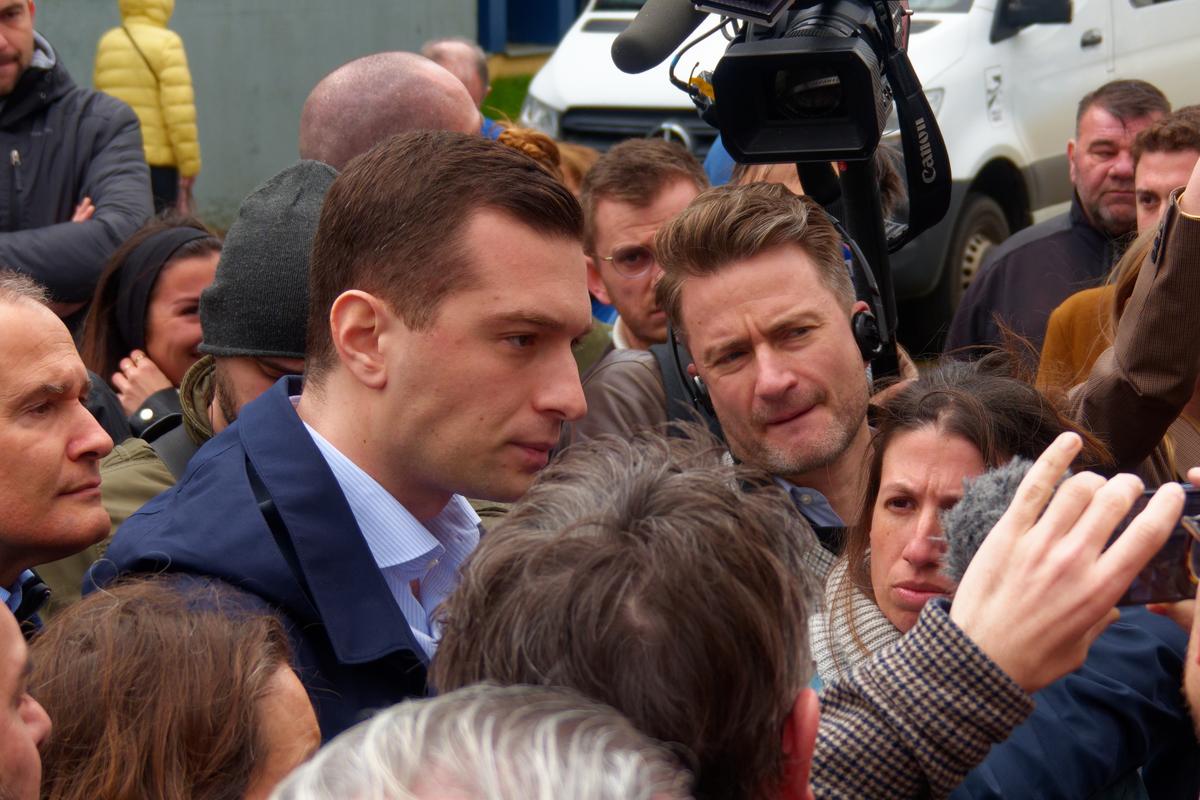
Jordan Bardella during a trip to Belfort on March 23, 2024. Credits: Thomas Bresson / Wikimedia Commons, CC BY 4.0.
On franceinfo on Wednesday, September 30, 2026, Fabrice Arfi announced new details about the antisemitic messages that Mediapart attributes to Jordan Bardella. The president of the National Rally denies having written them and says he will take legal action. With the 2027 presidential election approaching, the case concerns the authenticity of private conversations that the newspaper says it has verified, and the evidence it says it will make public.
A Demonstration Announced After Several Months of Investigation
“There will be a demonstration of what we wrote,” Fabrice Arfi said in his interview on franceinfo. The co-head of Mediapart’s investigations unit stands by the accusations published two days earlier. He is announcing a follow-up aimed at supporting the attribution of the writings to the RN leader.
The journalist places the start of the investigation in the spring. He describes work based on emails and private conversations, notably on Facebook and Messenger. He says several people and documents made the cross-checking possible. According to him, this variety of sources is a key element in the strength of the investigation.
2013 Exchanges Attributed To Bardella, Which He Denies
The case began on Monday, September 28, with the investigation by Alexandre Berteau and Antton Rouget, published at 3:27 p.m. Mediapart presents private conversations dating back to the early days of Jordan Bardella’s involvement in the National Front. The newspaper says it cross-checked these exchanges with testimony. Bardella, contacted before publication, denied it.
The messages cited, mainly dated 2013, advance antisemitic portrayals of an alleged control of banks and political power by Jews. The investigation also attributes to the young activist an embrace of certain conspiracy theories promoted by Alain Soral. Jordan Bardella rejects all of these accusations: he says he did not write the statements quoted.
In his initial response to Mediapart, quoted by AFP, he described the material cited as “crude fakes.” He also argued that he was a minor and, according to him, was not an active activist during the summer of 2013. He joined the FN in 2012. That political timeline, however, is not enough to establish that he was the author of the disputed conversations.

Lawsuits Announced And A Separate Prior Case
The president of the RN has chosen to take the dispute to court. He says he has filed a defamation complaint against Mediapart. On September 29, he also announced an action for forgery and use of forged documents if the newspaper published written material. He presents the investigation as an operation designed to derail his political future and his party’s presidential campaign.
These two announced steps target different things: the published accusations against him and the alleged fabrication of documents. For now, they remain Jordan Bardella’s statements. Asked Wednesday morning about the complaints, Fabrice Arfi said he was not aware of them. Announcing legal action does not allow one to predict the outcome, nor does it prove the alleged falsification denounced by the political leader.
Another development emerged Wednesday at 1:29 p.m. In a new article about a prior legal case, Mediapart reports that Jordan Bardella withdrew a defamation complaint against Bernard-Henri Lévy. According to the newspaper, that case followed remarks made by the writer in 2024, and the withdrawal reportedly came a few days before the trial.
This information concerns an earlier dispute. It is neither a ruling on the private exchanges now being challenged nor proof of their authenticity, which was promised that same morning. The two cases must be kept separate, even if they now fuel the standoff between the RN leader and Mediapart.
The RN Closes Ranks Ahead Of The Presidential Election
On Tuesday, during the meeting of RN lawmakers and their allies in the National Assembly, Marine Le Pen reaffirmed her confidence in Jordan Bardella. She promised to fight what she presents as a manipulation. The party president, for his part, described an offensive aimed at destabilizing the 2027 campaign. These accusations against the newspaper are the RN’s political response; they do not document a forgery.
The case involves a leader whom Marine Le Pen intends to appoint prime minister if she reaches the Élysée. It also comes as part of the continuation of the “de-demonization” strategy launched after she took over the National Front in 2011. That approach aims to present the party as fit to govern and to distance it from the legacy of Jean-Marie Le Pen, who was repeatedly convicted for Holocaust denial.
Asked by AFP after the investigation was published, Yonathan Arfi, president of the Representative Council of Jewish Institutions of France, said the revelations illustrated the limits of that strategy. Jordan Bardella, for his part, took part in March 2025 in a conference against antisemitism in Israel, at the invitation of the Israeli government.
Mediapart Denounces The Attacks And Stands By Its Investigation
The RN’s response has also sparked a conflict over comments directed at journalists. On September 29, Marine Le Pen advised Mediapart to put on a “Kevlar suit,” while announcing a response to its behavior. Kevlar is used, among other things, to make bulletproof protection.
In a text published the same day, Lénaïg Bredoux, the newspaper’s co-editorial director, denounced threatening remarks. On franceinfo Wednesday, Fabrice Arfi said he was concerned by the message sent by that language, while insisting that these attacks do not intimidate the newsroom.

On the substance, the next promised publication will need to shed light on one specific point: how the conversations were attributed to Jordan Bardella. The origin of the files, their dates, their integrity, and the cross-checks used to identify their author are at the heart of the issue. Fabrice Arfi’s interview sets out the method Mediapart says it used, without providing all of these technical details.
The repetition of the accusations in several media outlets does not, by itself, amount to additional authentication: it refers back to the same initial investigation. For the disputed messages, Mediapart’s claim and Jordan Bardella’s denial therefore remain the two positions on the table. The promised documents should make it possible to examine what sets them apart.